Key points
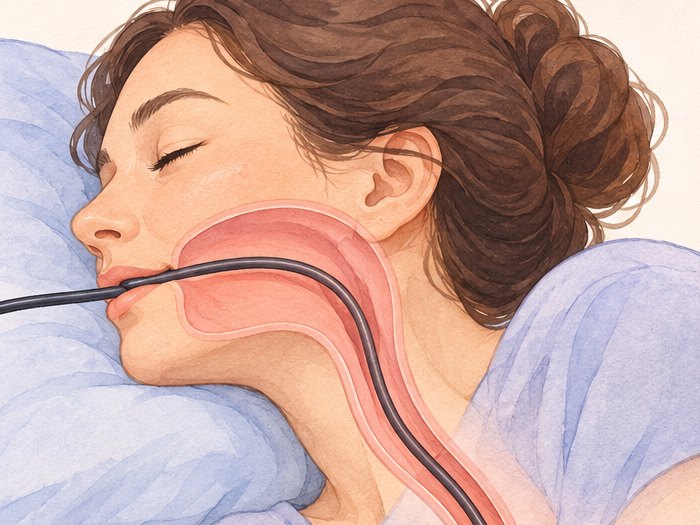
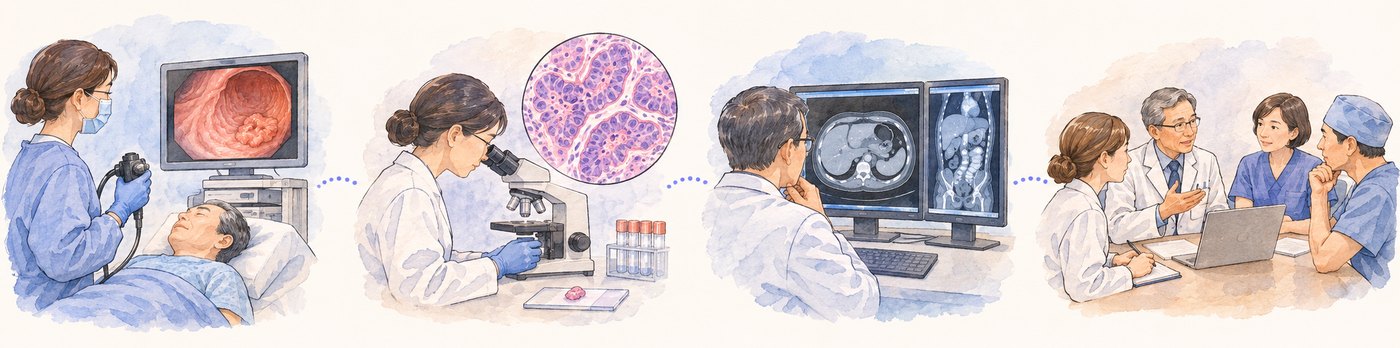
- The main test is an endoscopy: a thin, bendy tube with a camera, passed through the mouth to look inside the stomach.
- A tiny sample (biopsy) is taken and checked under a microscope. Only a biopsy can confirm cancer.
- Scans show how far the cancer has grown. This is called staging.
- Extra tests on the sample, called biomarkers, help doctors choose medicines.
1Step 1: Looking inside with an endoscopy (gastroscopy, OGDS)
You are given a throat spray or a medicine to make you sleepy. The doctor passes a thin tube with a camera through your mouth into your stomach. The test itself is usually quick. The doctor can see the lining on a screen and take tiny samples with a small tool. Taking a sample does not hurt.
2Step 2: Checking the sample (biopsy)
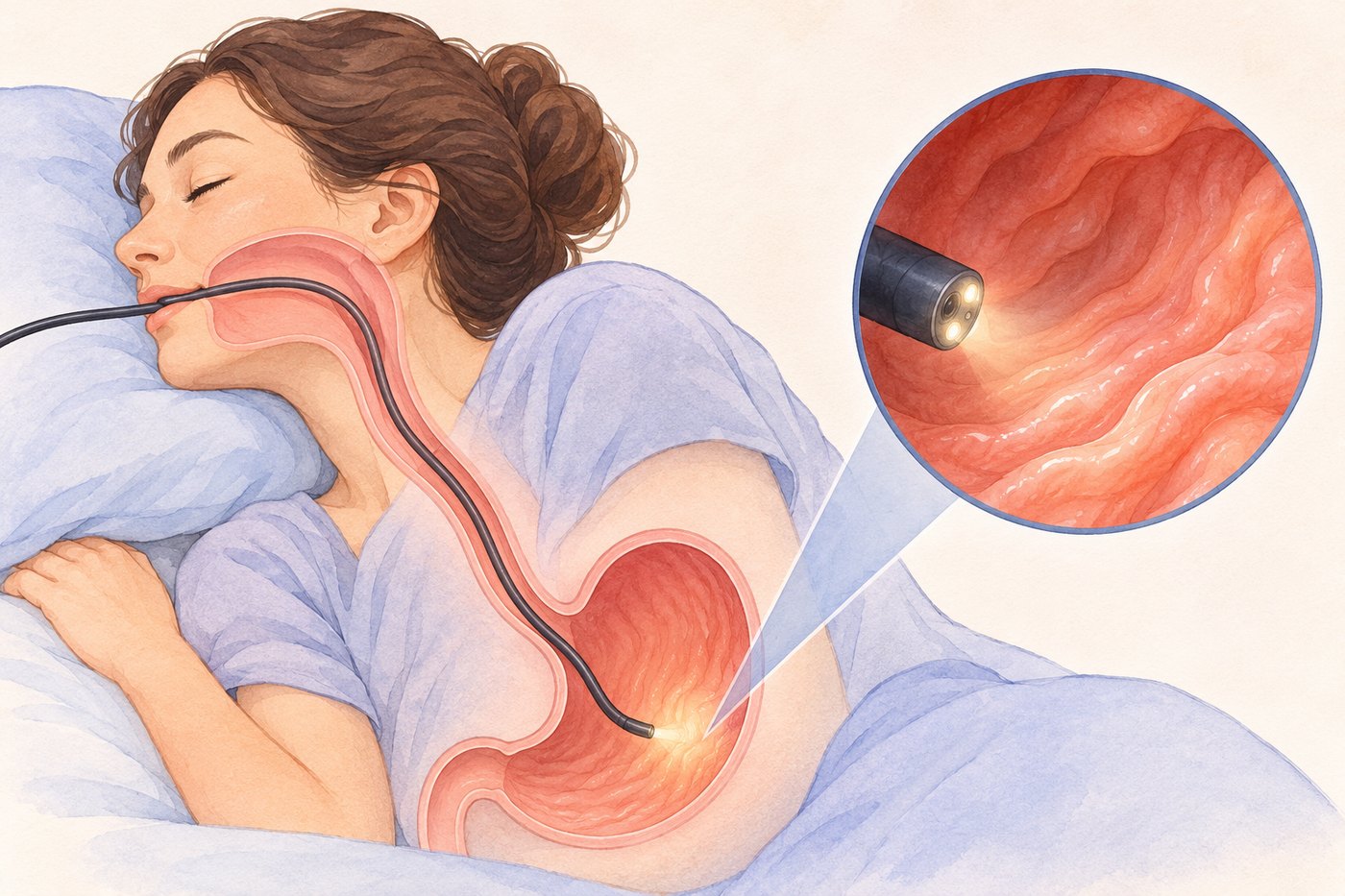
A specialist doctor called a pathologist looks at the sample under a microscope. The report says whether cancer cells are present and what type they are.
3Step 3: Finding the stage
| Test | What it is | Why it is done |
|---|---|---|
| CT scan | A ring-shaped X-ray machine that takes detailed pictures of the chest, tummy and pelvis | To see the tumour and check whether it has spread |
| Endoscopic ultrasound (EUS) | An endoscope with a tiny ultrasound probe on its tip | To see how deep the tumour goes into the stomach wall. Used for some people, mostly with early tumours |
| PET-CT scan | A scan that uses a small amount of radioactive sugar to light up active cells | Used for some people, not everyone |
| Staging laparoscopy | A short keyhole operation under general anaesthetic to look inside the tummy with a camera | To find tiny spots of spread that scans can miss, before planning major surgery |
| Blood tests | Blood count, kidney and liver tests, and sometimes tumour markers (CEA, CA 19-9) | To check general health. Tumour markers cannot diagnose cancer but may help with follow-up |
What do the stages of stomach cancer mean?
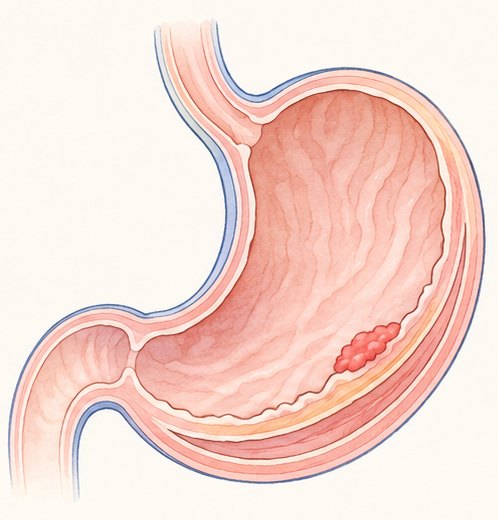 Stage 1The cancer is in the inner layers of the stomach wall.
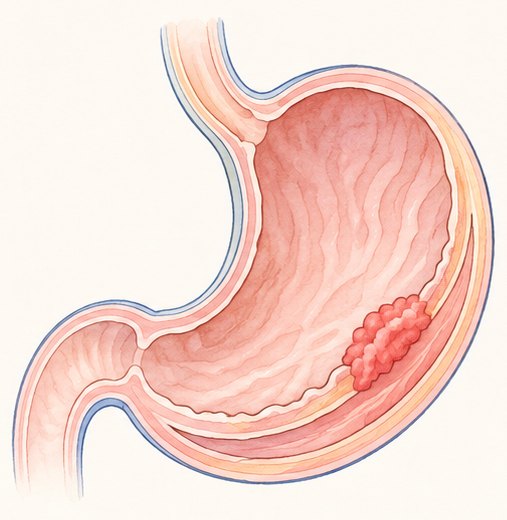 Stage 2It has grown deeper, or reached a few nearby lymph nodes.
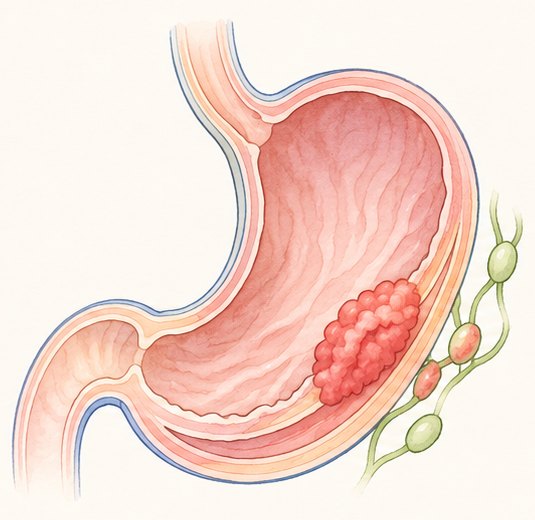 Stage 3It has grown through more of the wall, or reached more lymph nodes.
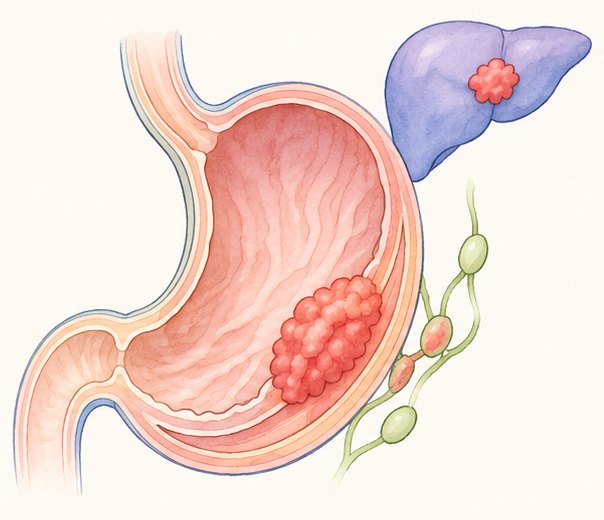 Stage 4It has spread to other parts of the body, such as the liver or the lining of the tummy.
Lymph nodes are small bean-shaped filters that are part of the body's defence system. Cancer cells can travel to them.
How do I read my biopsy report?
| Word on the report | What it means |
|---|---|
| Adenocarcinoma | Cancer that started in the stomach lining |
| Intestinal type / diffuse type | Two patterns the cancer cells can form. Diffuse type includes "signet ring" cells |
| Grade, or differentiation | How different the cancer cells look from normal cells |
| HER2, PD-L1, MSI or MMR, CLDN18.2 | Biomarkers. See below |
What are biomarkers? Clues that guide medicines
Biomarkers are features of the cancer cells. They do not tell you how serious the cancer is by themselves. They tell doctors which medicines are more likely to help. These tests are done on the biopsy sample, so no extra procedure is usually needed.
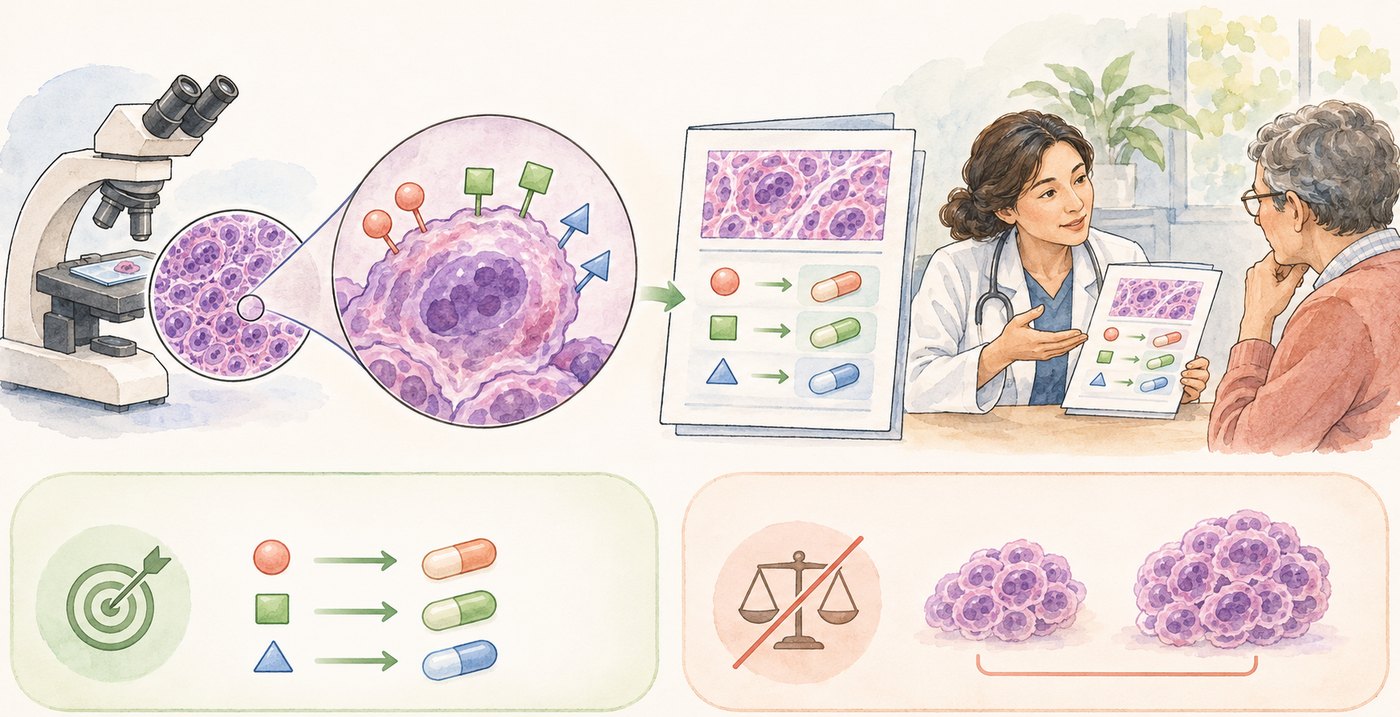
Want more detail? (Biomarkers for adenocarcinoma)
| Biomarker | What it is | Why it matters |
|---|---|---|
| HER2 | A protein on the cell surface that can tell cells to grow | If the cancer is HER2-positive and has spread, a HER2-targeting antibody can be added to chemotherapy18, 19 |
| PD-L1 (CPS score) | A protein that helps cancer cells hide from the immune system. CPS is a score of how much is present | Higher scores suggest more benefit from adding immunotherapy to chemotherapy20, 21 |
| MSI-H or dMMR | A sign that the cell's DNA "spell-checker" is not working | These cancers often respond well to immunotherapy22 |
| EBV | Epstein-Barr virus found inside the cancer cells | A distinct group of stomach cancers. Mostly of research interest for now17 |
| Claudin 18.2 (CLDN18.2) | A protein that normally sits hidden between stomach cells and becomes exposed in some cancers | If positive, HER2-negative and the cancer has spread, a claudin-targeting antibody can be added to chemotherapy in countries where it is approved23, 24 |
Want more detail? (About the tests)
- A pooled review found endoscopic ultrasound useful for judging tumour depth, but less reliable for telling very shallow tumours apart and for judging lymph nodes15.
- A Japanese review found CEA and CA 19-9 are not suitable for diagnosis but can help with staging and with watching for the cancer coming back, especially if they were raised before treatment16.
- Guidelines advise staging laparoscopy, sometimes with a wash of the tummy lining to look for cancer cells, for people with locally advanced cancer being considered for surgery13, 14.
- Doctors record the stage using the TNM system: T for how deep the tumour goes, N for lymph nodes, M for spread elsewhere.
Common questions
Does an endoscopy hurt?
It can feel uncomfortable, but it should not be painful. A throat spray or a sedative makes it easier. Taking a biopsy is not felt.
Can a blood test find stomach cancer?
No. Blood tests, including tumour markers, cannot confirm or rule out stomach cancer. Endoscopy with biopsy is needed.
References
- Al-Batran SE, et al. Gastric and oesophageal cancer: ESMO Clinical Practice Guideline for diagnosis, treatment and follow-up. Ann Oncol 2026 (published online October 2026). doi:10.1016/j.annonc.2026.09.015
- Japanese Gastric Cancer Association. Japanese gastric cancer treatment guidelines 2025 (7th edition). Gastric Cancer 2026;29(2):271–299. doi:10.1007/s10120-025-01698-4
- Mocellin S, et al. Diagnostic accuracy of endoscopic ultrasonography (EUS) for the preoperative locoregional staging of primary gastric cancer. Cochrane Database Syst Rev 2015;(2):CD009944. doi:10.1002/14651858.CD009944.pub2
- Shimada H, et al. Clinical significance of serum tumor markers for gastric cancer: a systematic review of literature by the Task Force of the Japanese Gastric Cancer Association. Gastric Cancer 2014;17(1):26–33. doi:10.1007/s10120-013-0259-5
- Cancer Genome Atlas Research Network. Comprehensive molecular characterization of gastric adenocarcinoma. Nature 2014;513(7517):202–209. doi:10.1038/nature13480
- Bang YJ, et al. Trastuzumab in combination with chemotherapy versus chemotherapy alone for treatment of HER2-positive advanced gastric or gastro-oesophageal junction cancer (ToGA). Lancet 2010;376(9742):687–697. doi:10.1016/S0140-6736(10)61121-X
- Janjigian YY, et al. Pembrolizumab plus trastuzumab and chemotherapy for HER2-positive gastric or gastro-oesophageal junction adenocarcinoma: interim analyses from the phase 3 KEYNOTE-811 trial. Lancet 2023;402(10418):2197–2208. doi:10.1016/S0140-6736(23)02033-0
- Janjigian YY, et al. Nivolumab plus chemotherapy as first-line treatment for advanced gastric, gastroesophageal junction, and esophageal adenocarcinoma: 5-year follow-up results from CheckMate 649. Ann Oncol 2026;37(6):787–797. doi:10.1016/j.annonc.2026.02.003
- Rha SY, et al. Pembrolizumab plus chemotherapy versus placebo plus chemotherapy for HER2-negative advanced gastric cancer (KEYNOTE-859). Lancet Oncol 2023;24(11):1181–1195. doi:10.1016/S1470-2045(23)00515-6
- Chao J, et al. Assessment of pembrolizumab therapy for the treatment of microsatellite instability-high gastric or gastroesophageal junction cancer among patients in the KEYNOTE-059, KEYNOTE-061, and KEYNOTE-062 clinical trials. JAMA Oncol 2021;7(6):895–902. doi:10.1001/jamaoncol.2021.0275
- Shitara K, et al. Zolbetuximab plus mFOLFOX6 in patients with CLDN18.2-positive, HER2-negative, untreated, locally advanced unresectable or metastatic gastric or gastro-oesophageal junction adenocarcinoma (SPOTLIGHT). Lancet 2023;401(10389):1655–1668. doi:10.1016/S0140-6736(23)00620-7
- Shah MA, et al. Zolbetuximab plus CAPOX in CLDN18.2-positive gastric or gastroesophageal junction adenocarcinoma: the randomized, phase 3 GLOW trial. Nat Med 2023;29(8):2133–2141. doi:10.1038/s41591-023-02465-7
For general education only. Not a substitute for consultation with a qualified doctor. Not a diagnosis or treatment advice.
If you have urgent symptoms such as vomiting blood, black tarry stools, severe tummy pain, fainting or difficulty breathing, go to the nearest emergency department or call 999.